
Advanced Tools Clamping System
The tools fixing device is a crucial part of the entire bending process. SMS provides a variety of clamping methods for customers to choose from, meeting customers' needs to the greatest extent.
Read MoreHydraulic Clamping System
The hydraulic clamping system is a more stable and safer die clamping method. It converts hydraulic energy into mechanical force through a hydraulic cylinder, thereby firmly fixing the die on the bending machine. This device can ensure that the die does not move due to force during the bending process, thereby reducing the accident risk and processing errors caused by die movement, and is often used in bending operations with high precision requirements.
Request A InformationFast Clamping System
Quick clamps, for upper dies of bending machines and mounted on sliding blocks, comprise a base and front pressure plate. They adjust dies for even force, protect blocks, and ensure workpiece precision. Some (e.g., double-sided ones) fix via bottom-up pushing, have limit switches for easy die handling, allow reverse installation, suit inward-flange workpieces, and cut repeated die-opening costs.
Request A InformationManual Clamping System
This is a relatively basic fixing method. It usually requires the operator to manually lock the clamping plate to fix the die, and is equipped with an automatic seating and automatic calibration mechanism. It can provide consistent clamping force over the entire working length, eliminating the need for further adjustment after each section of the die is clamped, and enabling precise centering and seating of the die.
Request A Information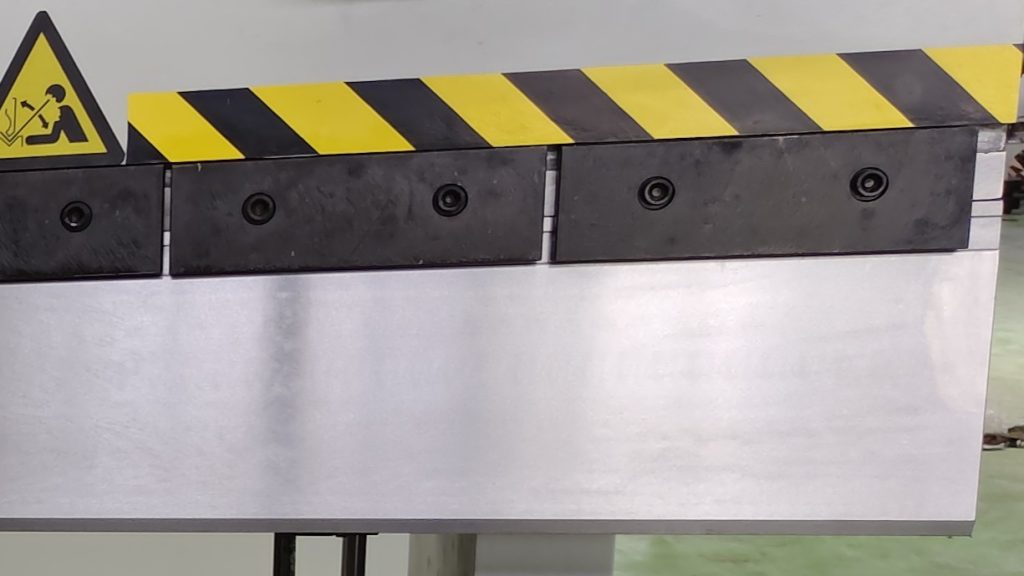
Promecam European Heavy-Duty Fixture
This fixture system is not a single component, but consists of multiple elements, including the bending machine beam, upper fixture, intermediate part, lower fixture, and punch.
High-quality European materials are adopted, such as C45, C45 quenched steel, or Cr 42 Mo 4. The hardness of their working surfaces can reach HRC55 - 60 or HRC52 - 58. Through professional induction hardening treatment, they feature strong wear resistance and good precision retention.
Request A Information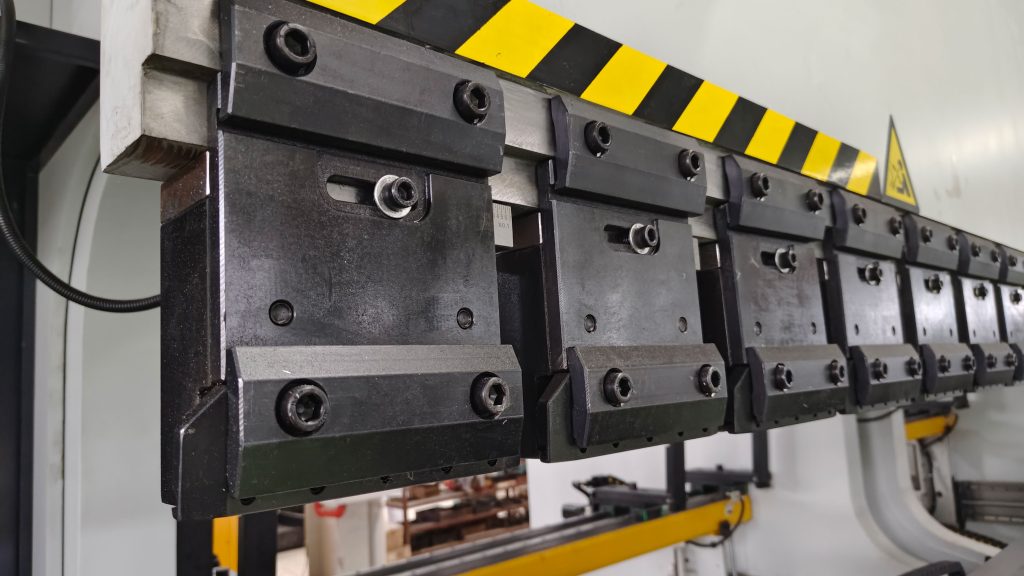
How to Choose a Suitable Press Brake Fixture?
| Comparison Criteria | Hydraulic Clamping | Manual Clamping |
|---|---|---|
Power Source |
Hydraulic system, which provides clamping force through a hydraulic cylinder. |
Manual operation, relying on tools such as wrenches and bolts. |
Clamping Force |
The clamping force is large and uniform, and can remain consistent over the entire length of the die. |
The clamping force depends on the operator’s strength, making it prone to uneven tightness in local areas. |
Operating Efficiency |
One-click start, fast clamping/releasing speed, and short time consumed for die replacement |
Bolts need to be locked/tightened and removed one by one manually, resulting in cumbersome operation and long die changeover time. |
Stability and Precision |
The clamping force is stable, the die is not prone to displacement, and the machining error is small. |
The clamping force is unstable, and it tends to loosen after long-term use or when subjected to force, which affects precision. |
Applicable Scenarios |
Mass production, bending of thick plates/high-strength materials, and high-precision machining requirements |
Small-batch trial production, simple bending of thin plates, and scenarios with low precision requirements |
Maintenance Cost |
The structure is relatively complex, requiring regular maintenance of the hydraulic system (including oil replacement and seal inspection). |
The structure is simple, with almost no additional maintenance costs, and only requires inspection of bolt wear. |
Safety |
Equipped with a pressure protection device, it automatically relieves pressure in case of overload, ensuring high safety. |
It relies on manual locking; if operated improperly, the die is prone to loosening, posing potential safety hazards. |